Tuesday, July 08, 2008

THERE IS NO SECURITY FOR YOU AND ME

The Illusion of Security

July 7, 2008 | From theTrumpet.com

During the 1930s the British people thought there would never be another world war. The 1940s shattered those illusions!

Germany spent the 1930s preparing for war. Britain, on the other hand, spent the 1930s seeking the comforts and pleasures of life. People wanted the easy way of self-indulgence.

Winston Churchill commented on this phenomenon (Martin Gilbert, The Prophet of Truth; emphasis mine throughout):

I must say that I am astounded at the wave of optimism, of confidence, and even of complacency, which has swept over Parliament and over public opinion. There is a veritable tide of feeling that all is well, that everything is being done in the right way, in the right measure, and in the right time.

The Labor Party refused to even support rearmament in spite of Churchill’s warnings. Most people had convinced themselves that there would never be another war after World War i. Nobody who understands human nature could reach such a conclusion. Such naive reasoning always leads into dangerous deception.

Our being deceived before World War ii also reveals a greater potential danger. Many people also thought World War ii was the war to end all wars. Because we don’t understand our evil human nature we are easily deceived, which puts us in much greater danger today. We can ill afford such deception in this age of potential nuclear destruction. (Request our free booklet Human Nature: What Is It?)

Churchill also warned, “We are in the midst of dangers so great and increasing, we are the guardians of causes so precious to the world, that we must, as the Bible says, ‘Lay aside every impediment.’”

Martin Gilbert wrote (ibid.):

On October 3 Churchill was present at the Oxford High School for Boys, for the unveiling of a memorial to T.E. Lawrence [Lawrence of Arabia], who had been killed in a motorcycle accident in May 1935. “All feel the poorer that he has gone from us,” Churchill said. “In these days dangers and difficulties gather upon Britain and her empire, and we are also conscious of a lack of outstanding figures with which to overcome them.

Lloyd George, one of Britain’s most prominent leaders (prime minister in World War i), praised Hitler as the greatest German leader of the age. This was said in 1935, after Hitler had murdered political opponents and instituted racism. Such statements were criminal—the opposite of what a great leader should have said.

It takes great men to lead us to face huge problems. That is a sobering truth which also escapes us today. Today, as before World War ii, politics and the press often keep outstanding leaders out of office.

Winston Churchill didn’t get a leadership role until AFTER the war began, even though he strongly warned the British people about Hitler and Germany for seven or eight years! He was kept out of office by politicians, educational institutions and the press. Today, nations have nuclear weapons and the power to deliver them in minutes. If we make the same mistake Britain and America made in World War ii, our nations will not survive!

That is why I keep saying we must learn from the horrendous mistakes we made before and during World War ii—or we will wake up too late. And just as Churchill warned Britain before World War ii, we are experiencing the same lack of will against strong dictators today. History warns about this disastrous kind of retreat. Churchill said, “Parliament is dead as mutton.” The leaders and the people had no real sense of the approaching danger of World War ii. They didn’t see the danger, so they didn’t prepare for it. And they drifted into this precarious condition. They were moving “towards some hideous catastrophe.”

Today Britain and America are drifting toward a far more hideous catastrophe! That is why the World War ii lesson is so vital!

If we drifted so recently (World War ii), is it alarmist to think we could do it again? “I feel our country’s safety is fatally imperilled both by its lack of arms and by the government’s attitude towards the Nazi gangsters,” Churchill said. “It is fostering in them the dangerous belief that they need not fear interference by us whatever they do. That can only encourage those savages to acts of aggression and violence of every kind. I have, therefore, chosen to go my own way and to act independently in order to further the safety of our country and of the civilization without which we cannot survive as a nation” (ibid.).

Churchill knew that if Britain fell, Europe would also fall and perhaps the whole of Western civilization, including America. Some people may have forgotten how close we came to destruction in World War ii. It will be to our own deadly peril if we fail to remember.

Neville Chamberlain tried to make friends with Mussolini and Italy. One of Chamberlain’s strongest cabinet members, Anthony Eden, resigned. This was one of Churchill’s blackest moments (ibid.):

I must confess that my heart sank, and for a while the dark waters of despair overwhelmed me. From midnight till dawn I lay in my bed consumed by emotions of sorrow and fear. There seemed one strong young figure standing up against long, dismal, drawling tides of drift and surrender, of wrong measurements and feeble impulses. My conduct of affairs would have been different from his in various ways; but he seemed to me at this moment to embody the life-hope of the British nation, the grand old British race that had done so much for men, and had yet some more to give. Now he was gone. I watched the daylight slowly creep in through the windows, and saw before me in mental gaze the vision of death.

Churchill believed that Britain’s great empire, built over centuries, could be destroyed suddenly. He was in deep sorrow, fear and despair as he watched his beloved nation drift toward disaster. But that was a mild crisis compared to the one we face today. We first must experience some of Churchill’s sorrow and fear to be motivated to change. There is hope only if we face reality and have the vision of what is on the horizon.

Austria Falls

Most people today believe that when Germany seized Austria, only 25-35 percent of the Austrians supported Hitler. “Within 24 hours of the German invasion of Austria, all the brutal apparatus of Nazi tyranny was put into effect. Throughout Sunday, March 13 [1938], and in the days and weeks that followed, all those suspected of hostility to the new order were arrested and sent to concentration camps. Many hundreds were shot. Others, fearful of Nazi terror, committed suicide” (ibid.).

The weak-willed media continued to deceive the people, even after Austria was conquered, aiding Hitler more than many of his own soldiers!

Our media today should have learned a powerful lesson from that history. Instead they are far more weak-willed and deceived today! Martin Gilbert wrote:

The division of opinion was exacerbated by the attitude of the press [even as Hitler kept gobbling up Europe]. The Times in particular urged the Czechs to make concessions to Germany, and argued that it was Czech obstinacy that was the main obstacle to a peaceful settlement. Yet even the factual reports in the Times did not give a true picture of the nature of Nazi rule. On March 18 Churchill was sent a firsthand account of events in Vienna since the German occupation from a young acquaintance, David Hindley-Smith, who had been angered by reports in the Times that Hitler had received an enthusiastic welcome from an overwhelming majority of Austrians. …

“Is our system of government adapted to the present fierce, swift movement of events? Twenty-two gentlemen of blameless party character sitting round an overcrowded table, each having a voice—is that a system which can reach decisions from week to week and cope with the problems descending upon us and with the men at the head of the dictator states? [He was wondering if a democracy was adequate in times of war. He was making a case for stronger rule from the top.] It broke down hopelessly in the war [World War i].

“But is this peace in which we are living? Is it not war without cannon firing? Is it not war of a decisive character, where victories are gained and territories conquered, and where ascendancy and dominance are established over large populations with extraordinary rapidity?”

Churchill went on to warn of the dangers of allowing any momentary easing of tension to lead to complacency. “After a boa constrictor has devoured its prey,” he said, “it often has a considerable digestive spell.” There had been a pause after each German move—after the revelation that a secret air force had been set up, after the proclamation of conscription, and again after the militarization of the Rhineland. He went on:

“Now, after Austria has been struck down, we are all disturbed and alarmed, but in a little while there may be another pause. There may not, we cannot tell. But if there is a pause, then people will be saying, ‘See how the alarmists have been confuted; Europe has calmed down, it has all blown over, and the war scare has passed away.’ The prime minister will perhaps repeat what he said a few weeks ago, that the tension in Europe is greatly relaxed. The Times will write a leading article to say how silly people look who, on the morrow of the Austrian incorporation, raised a clamor for exceptional action in foreign policy and home defense, and how wise the government were not to let themselves be carried away by this passing incident.”

The Times was considered by many to be the greatest newspaper in the world. It had thundered many accurate warnings in the past to build its reputation. It was recognized as the voice of the British government. Now, it had descended to this: rebuking the Czechs as being “obstinate,” since they would not voluntarily give a large portion of their country to the vile Nazis! It labeled the Czechs as the obstacle to peace—not Hitler! How could a revered institution pollute the truth so badly? And its reports grotesquely distorted Austria’s image in a dangerous way. It was a powerful support to Hitler’s people-enslaving and people-destroying war machine! Its own weakness and fear stained its reputation for years to come. Much of its reporting in the 1930s was a crime against humanity!

Because they were consumed with fear, the truth was cast aside. Such powerful institutions must be held more accountable. And we trust them at our own peril!

Has the media learned from their shameful mistakes of the 1930s?

The press deceived themselves about what was really happening. But not Churchill. He kept writing and speaking against this tragedy.

Most of the newspapers which had printed his speeches and articles stopped doing so. Even the people, on average, were more inclined to agree with Winston Churchill than the press.

Churchill was great enough to rise above the media, educational institutions and politics. Do we have any such leaders today?

American Tragedy

Churchill kept encouraging America to support the defense of Europe. “America’s attitude is vital to morale,” Colville noted in his diary, “but America is the slowest to act of all the democracies” (ibid.).

Even some of America’s news networks were against Edward R. Murrow’s strong cbs broadcasts condemning Hitler. They feared that America’s neutrality would be compromised.

But neutral is a heinous word under those conditions! Being neutral between Hitler’s Nazis and Britain was a shameful evil. And when would we have stopped being neutral if Japan hadn’t bombed us into the war at Pearl Harbor?

Our press often fails to make strong judgments against evil deeds committed today. They too often behave as though God and the devil should have equal time. This lack of judgment and courage allows the political leaders and their “spin doctors” to play the press like a fiddle. They are used and abused by politicians. As a result, many people become confused and deceived.

America should be ashamed of this history, before and during World War ii. Not just in words. A radical lesson must be learned, or we are destined to repeat the history—which will mean a deadly calamity!

Many authorities say World Wars i and ii were the greatest tragedies of our century. I disagree. The worst catastrophe is that we failed to learn a lesson from Churchills warning! That means we have retained our deadly capacity for deception into the nuclear age. That is why we are destined to experience a nuclear holocaust unless we wake up!

“What price have we all to pay for this?” Churchill asked. “No one can compute it. Small countries in Europe will take their cue to move to the side of power and resolution” (ibid.). Other nations did move closer to Hitler because of his power and strong will. At the same time, they were turning away from Britain because of its weak will.

That is exactly what is happening today with the U.S. Though we have a greater military than any nation on Earth, we lack the will to use it. That is a major reason why other nations hate us and fail to support our policies.

“So they go on in strange paradox,” Churchill continued, “decided only to be undecided, resolved to be irresolute, adamant for drift, solid for fluidity, all powerful to be impotent. So we go on preparing more months and years—precious, perhaps vital, to the greatness of Britain—for the locusts to eat” (ibid.). America shared that deadly pacifism.

“Fool’s Paradise”

Winston Churchill’s own Conservative Party was turning against him. “The House of Commons listened to him with what he later described as ‘a patient air of skepticism.’ There were frequent, angry interruptions, and his criticisms of Chamberlain were widely resented by his fellow Conservative mps. Bitterly he told them: ‘You are casting away real and important means of security and survival for vain shadows and for ease’” (ibid.).

The people wanted to continue in a peace-time atmosphere. Churchill tried to get them into an emergency posture, in tune with what Hitler was doing. Churchill served as an outstanding watchman for the whole Western world. But it hated the messenger and rejected the message!

The people wanted to believe they were living in ordinary times (ibid.):

On June 8 [1938] Brigadier-General Edmonds, his former literary assistant, wrote from the Historical Section of the Committee of Imperial Defense: “Providence looks after us and confounds our enemies, but expects ‘works’ as well as faith. To ensure peace we must be strong.” But many people took it for granted that Britain was already strong, and even the News of the World, which had on May 1 published Churchill’s major warning, began to assure its readers that all was well .

Even those who published Churchill’s major warning didn’t believe him! It’s as if they were in a coma of deception! Those institutions that should have helped Churchill, worked against him. As Churchill said, this helped the people continue “living in a ‘fool’s paradise.’” Gilbert continued:

On June 24 George Harrap published the selection of the speeches which Churchill had made on defense and foreign affairs in the 10 years since 1928. Entitled Arms and the Covenant, the volume had been both suggested and edited by Randolph, and was welcomed by his friends. … The South African writer Sarah Gertrude Millin, whom Churchill had met during her visit to England that summer, wrote on 15 Dec., 1938, “The book reads like a toll and knell of doom. All that heartens me is that you yourself, as I saw, have still more heart than any other person I have met in England.

This book helped those who would listen to see how accurate Churchill’s prophecies and warnings were! Anybody who sought the truth could find it. But the people didn’t want to hear the truth. That was at the heart of the problem. The people wanted to hear “smooth things” and “deceits” (Isaiah 30:10). They wanted to be deceived! That is the biggest challenge each one of us must always face: Do we really want to hear the truth?

Sometimes hearing truth can be the most painful experience of our lives. It often means ripping wrong ideas from our proud minds. But the truth sets us free and greatly enriches our lives.

Czechoslovakia Falls

Hitler soon demanded that the Sudetenland of Czechoslovakia be given to Germany. He said it was because many Germans lived there. But most of the Germans there did not want his rule!

Here is a shocking statement made public long after the war: “Unknown to anyone outside his secret circle, Hitler was already contemplating a dramatic outcome. ‘I will decide to take action against Czechoslovakia,’ he had informed General Keitel on June 18, ‘only if I am firmly convinced, as in the case of the demilitarized zone and the entry into Austria, that France will not march, and that therefore England will not intervene’” (ibid.).

Hitler was going to take action only if he was firmly convinced that France and Britain would not intervene!

This statement greatly exposes the mind of a tyrant, which America and Britain generally refuse to understand. It is not complicated. It’s very simple. But it also reveals a lot about our nations. It clearly shows that we are weak and fearful nations when facing tyrannical dictators.

It was vastly different in much of America’s history. Theodore Roosevelt, for example, never backed down from a tyrant!

There is a very strong and clear message in all this: Tyrants always prey on weakness. All they ever understand and respect is superior force.

Why can’t our well-educated people understand this? Because they reason out of vanity, weakness and fear. That means your greatest enemy is yourself! Until we face our own weaknesses and fears, we are condemned to repeat our past mistakes.

Germany started and lost World War i. The Allied powers imposed upon the Germans the Treaty of Versailles, which prohibited them from entering into a demilitarized zone in their own nation. In the 1930s Germany broke that treaty in every way. It took military control of the demilitarized area. The world watched and did nothing, fearful that opposing the Germans would lead to war. Then when Hitler seized Austria in 1938, again the world watched and did nothing. People feared it would cause a war if they stood up to the Nazis.

Hitler marched into those areas because he saw how weak Britain, France and America were. The same evaluation was being used with Czechoslovakia. (Request our free book The United States and Britain in Prophecy.)

Now we can better see why Churchill called World War ii “the unnecessary war.” He believed it could have been prevented if the democracies of Europe had stood up to Hitler in the beginning.

Churchill was the only British leader the Germans feared. That fact alone should have gotten him into the British Cabinet. Instead, it was the main reason he was kept out! Gilbert continued

On August 7 the British military attaché in Berlin, Colonel Mason-Macfarlane, reported secretly to the Foreign Office that Hitler had already decided to attack Czechoslovakia in September, whatever agreement Benes [the Czech leader] might reach with the Sudetens. Six days later the Conservative mp Charles Taylor, who had been traveling in Germany, informed the Foreign Office of massive German troop movements between Nuremberg and the Czech frontier. That same day Churchill wrote to Lloyd George: “Everything is overshadowed by the impending trial of willpower which is developing in Europe. I think we shall have to choose in the next few weeks between war and shame, and I have very little doubt what the decision will be.”

As the German troop movements grew, with over 1½ million men under arms, Hitler announced that he was holding the usual peace-time maneuvers. His announcement was widely accepted by the British and French public, for, as Orme Sargent noted in a Foreign Office minute on August 15, the French press had probably received the samehintas the Britishto write down the German mobilization as much as possible so as not to create a sudden panic.” Churchill, however, in an article in the Daily Telegraph on August 18, warned that “if the optimists were proved wrong,” the governments who shared their views would find themselves “at an enormous disadvantage in the opening stages of a world war.” His article continued: “It would be only common prudence for other countries besides Germany to have these same kind of maneuvers at the same time and to place their precautionary forces in such a position that, should the optimists be wrong, they would not be completely ruined.”

What logical and practical advice. But it was rejected. Of course, the democracies ended up getting war—and shame!

Churchill thought America would come in sooner than it did in World War i. “The feeling in the United States against Germany is now far stronger than it was even in 1914,” he said. “In fact, there never has been in time of peace so fierce a feeling against any European country. It seems to me very likely that the United States would not wait so long this time before coming in themselves” (ibid.). Sadly, Churchill was wrong and the U.S. waited a long time before entering, just as it did in World War i.

Like Britain, it wasn’t until the Japanese shattered America’s illusions of security at Pearl Harbor that it decided to enter the war!

Today, the peoples of America and Britain refuse to learn this powerful lesson: While illusions of security feel good for a time, they are always shattered by the jackboot of reality!

Monday, July 07, 2008

YOU ARE LIVING IN A FANTASY WORLD

The Illusion of Security

July 7, 2008 | From theTrumpet.com

During the 1930s the British people thought there would never be another world war. The 1940s shattered those illusions!

Germany spent the 1930s preparing for war. Britain, on the other hand, spent the 1930s seeking the comforts and pleasures of life. People wanted the easy way of self-indulgence.

Winston Churchill commented on this phenomenon (Martin Gilbert, The Prophet of Truth; emphasis mine throughout):

I must say that I am astounded at the wave of optimism, of confidence, and even of complacency, which has swept over Parliament and over public opinion. There is a veritable tide of feeling that all is well, that everything is being done in the right way, in the right measure, and in the right time.

The Labor Party refused to even support rearmament in spite of Churchill’s warnings. Most people had convinced themselves that there would never be another war after World War i. Nobody who understands human nature could reach such a conclusion. Such naive reasoning always leads into dangerous deception.

Our being deceived before World War ii also reveals a greater potential danger. Many people also thought World War ii was the war to end all wars. Because we don’t understand our evil human nature we are easily deceived, which puts us in much greater danger today. We can ill afford such deception in this age of potential nuclear destruction. (Request our free booklet Human Nature: What Is It?)

Churchill also warned, “We are in the midst of dangers so great and increasing, we are the guardians of causes so precious to the world, that we must, as the Bible says, ‘Lay aside every impediment.’”

Martin Gilbert wrote (ibid.):

On October 3 Churchill was present at the Oxford High School for Boys, for the unveiling of a memorial to T.E. Lawrence [Lawrence of Arabia], who had been killed in a motorcycle accident in May 1935. “All feel the poorer that he has gone from us,” Churchill said. “In these days dangers and difficulties gather upon Britain and her empire, and we are also conscious of a lack of outstanding figures with which to overcome them.

Lloyd George, one of Britain’s most prominent leaders (prime minister in World War i), praised Hitler as the greatest German leader of the age. This was said in 1935, after Hitler had murdered political opponents and instituted racism. Such statements were criminal—the opposite of what a great leader should have said.

It takes great men to lead us to face huge problems. That is a sobering truth which also escapes us today. Today, as before World War ii, politics and the press often keep outstanding leaders out of office.

Winston Churchill didn’t get a leadership role until AFTER the war began, even though he strongly warned the British people about Hitler and Germany for seven or eight years! He was kept out of office by politicians, educational institutions and the press. Today, nations have nuclear weapons and the power to deliver them in minutes. If we make the same mistake Britain and America made in World War ii, our nations will not survive!

That is why I keep saying we must learn from the horrendous mistakes we made before and during World War ii—or we will wake up too late. And just as Churchill warned Britain before World War ii, we are experiencing the same lack of will against strong dictators today. History warns about this disastrous kind of retreat. Churchill said, “Parliament is dead as mutton.” The leaders and the people had no real sense of the approaching danger of World War ii. They didn’t see the danger, so they didn’t prepare for it. And they drifted into this precarious condition. They were moving “towards some hideous catastrophe.”

Today Britain and America are drifting toward a far more hideous catastrophe! That is why the World War ii lesson is so vital!

If we drifted so recently (World War ii), is it alarmist to think we could do it again? “I feel our country’s safety is fatally imperilled both by its lack of arms and by the government’s attitude towards the Nazi gangsters,” Churchill said. “It is fostering in them the dangerous belief that they need not fear interference by us whatever they do. That can only encourage those savages to acts of aggression and violence of every kind. I have, therefore, chosen to go my own way and to act independently in order to further the safety of our country and of the civilization without which we cannot survive as a nation” (ibid.).

Churchill knew that if Britain fell, Europe would also fall and perhaps the whole of Western civilization, including America. Some people may have forgotten how close we came to destruction in World War ii. It will be to our own deadly peril if we fail to remember.

Neville Chamberlain tried to make friends with Mussolini and Italy. One of Chamberlain’s strongest cabinet members, Anthony Eden, resigned. This was one of Churchill’s blackest moments (ibid.):

I must confess that my heart sank, and for a while the dark waters of despair overwhelmed me. From midnight till dawn I lay in my bed consumed by emotions of sorrow and fear. There seemed one strong young figure standing up against long, dismal, drawling tides of drift and surrender, of wrong measurements and feeble impulses. My conduct of affairs would have been different from his in various ways; but he seemed to me at this moment to embody the life-hope of the British nation, the grand old British race that had done so much for men, and had yet some more to give. Now he was gone. I watched the daylight slowly creep in through the windows, and saw before me in mental gaze the vision of death.

Churchill believed that Britain’s great empire, built over centuries, could be destroyed suddenly. He was in deep sorrow, fear and despair as he watched his beloved nation drift toward disaster. But that was a mild crisis compared to the one we face today. We first must experience some of Churchill’s sorrow and fear to be motivated to change. There is hope only if we face reality and have the vision of what is on the horizon.

Austria Falls

Most people today believe that when Germany seized Austria, only 25-35 percent of the Austrians supported Hitler. “Within 24 hours of the German invasion of Austria, all the brutal apparatus of Nazi tyranny was put into effect. Throughout Sunday, March 13 [1938], and in the days and weeks that followed, all those suspected of hostility to the new order were arrested and sent to concentration camps. Many hundreds were shot. Others, fearful of Nazi terror, committed suicide” (ibid.).

The weak-willed media continued to deceive the people, even after Austria was conquered, aiding Hitler more than many of his own soldiers!

Our media today should have learned a powerful lesson from that history. Instead they are far more weak-willed and deceived today! Martin Gilbert wrote:

The division of opinion was exacerbated by the attitude of the press [even as Hitler kept gobbling up Europe]. The Times in particular urged the Czechs to make concessions to Germany, and argued that it was Czech obstinacy that was the main obstacle to a peaceful settlement. Yet even the factual reports in the Times did not give a true picture of the nature of Nazi rule. On March 18 Churchill was sent a firsthand account of events in Vienna since the German occupation from a young acquaintance, David Hindley-Smith, who had been angered by reports in the Times that Hitler had received an enthusiastic welcome from an overwhelming majority of Austrians. …

“Is our system of government adapted to the present fierce, swift movement of events? Twenty-two gentlemen of blameless party character sitting round an overcrowded table, each having a voice—is that a system which can reach decisions from week to week and cope with the problems descending upon us and with the men at the head of the dictator states? [He was wondering if a democracy was adequate in times of war. He was making a case for stronger rule from the top.] It broke down hopelessly in the war [World War i].

“But is this peace in which we are living? Is it not war without cannon firing? Is it not war of a decisive character, where victories are gained and territories conquered, and where ascendancy and dominance are established over large populations with extraordinary rapidity?”

Churchill went on to warn of the dangers of allowing any momentary easing of tension to lead to complacency. “After a boa constrictor has devoured its prey,” he said, “it often has a considerable digestive spell.” There had been a pause after each German move—after the revelation that a secret air force had been set up, after the proclamation of conscription, and again after the militarization of the Rhineland. He went on:

“Now, after Austria has been struck down, we are all disturbed and alarmed, but in a little while there may be another pause. There may not, we cannot tell. But if there is a pause, then people will be saying, ‘See how the alarmists have been confuted; Europe has calmed down, it has all blown over, and the war scare has passed away.’ The prime minister will perhaps repeat what he said a few weeks ago, that the tension in Europe is greatly relaxed. The Times will write a leading article to say how silly people look who, on the morrow of the Austrian incorporation, raised a clamor for exceptional action in foreign policy and home defense, and how wise the government were not to let themselves be carried away by this passing incident.”

The Times was considered by many to be the greatest newspaper in the world. It had thundered many accurate warnings in the past to build its reputation. It was recognized as the voice of the British government. Now, it had descended to this: rebuking the Czechs as being “obstinate,” since they would not voluntarily give a large portion of their country to the vile Nazis! It labeled the Czechs as the obstacle to peace—not Hitler! How could a revered institution pollute the truth so badly? And its reports grotesquely distorted Austria’s image in a dangerous way. It was a powerful support to Hitler’s people-enslaving and people-destroying war machine! Its own weakness and fear stained its reputation for years to come. Much of its reporting in the 1930s was a crime against humanity!

Because they were consumed with fear, the truth was cast aside. Such powerful institutions must be held more accountable. And we trust them at our own peril!

Has the media learned from their shameful mistakes of the 1930s?

The press deceived themselves about what was really happening. But not Churchill. He kept writing and speaking against this tragedy.

Most of the newspapers which had printed his speeches and articles stopped doing so. Even the people, on average, were more inclined to agree with Winston Churchill than the press.

Churchill was great enough to rise above the media, educational institutions and politics. Do we have any such leaders today?

American Tragedy

Churchill kept encouraging America to support the defense of Europe. “America’s attitude is vital to morale,” Colville noted in his diary, “but America is the slowest to act of all the democracies” (ibid.).

Even some of America’s news networks were against Edward R. Murrow’s strong cbs broadcasts condemning Hitler. They feared that America’s neutrality would be compromised.

But neutral is a heinous word under those conditions! Being neutral between Hitler’s Nazis and Britain was a shameful evil. And when would we have stopped being neutral if Japan hadn’t bombed us into the war at Pearl Harbor?

Our press often fails to make strong judgments against evil deeds committed today. They too often behave as though God and the devil should have equal time. This lack of judgment and courage allows the political leaders and their “spin doctors” to play the press like a fiddle. They are used and abused by politicians. As a result, many people become confused and deceived.

America should be ashamed of this history, before and during World War ii. Not just in words. A radical lesson must be learned, or we are destined to repeat the history—which will mean a deadly calamity!

Many authorities say World Wars i and ii were the greatest tragedies of our century. I disagree. The worst catastrophe is that we failed to learn a lesson from Churchills warning! That means we have retained our deadly capacity for deception into the nuclear age. That is why we are destined to experience a nuclear holocaust unless we wake up!

“What price have we all to pay for this?” Churchill asked. “No one can compute it. Small countries in Europe will take their cue to move to the side of power and resolution” (ibid.). Other nations did move closer to Hitler because of his power and strong will. At the same time, they were turning away from Britain because of its weak will.

That is exactly what is happening today with the U.S. Though we have a greater military than any nation on Earth, we lack the will to use it. That is a major reason why other nations hate us and fail to support our policies.

“So they go on in strange paradox,” Churchill continued, “decided only to be undecided, resolved to be irresolute, adamant for drift, solid for fluidity, all powerful to be impotent. So we go on preparing more months and years—precious, perhaps vital, to the greatness of Britain—for the locusts to eat” (ibid.). America shared that deadly pacifism.

“Fool’s Paradise”

Winston Churchill’s own Conservative Party was turning against him. “The House of Commons listened to him with what he later described as ‘a patient air of skepticism.’ There were frequent, angry interruptions, and his criticisms of Chamberlain were widely resented by his fellow Conservative mps. Bitterly he told them: ‘You are casting away real and important means of security and survival for vain shadows and for ease’” (ibid.).

The people wanted to continue in a peace-time atmosphere. Churchill tried to get them into an emergency posture, in tune with what Hitler was doing. Churchill served as an outstanding watchman for the whole Western world. But it hated the messenger and rejected the message!

The people wanted to believe they were living in ordinary times (ibid.):

On June 8 [1938] Brigadier-General Edmonds, his former literary assistant, wrote from the Historical Section of the Committee of Imperial Defense: “Providence looks after us and confounds our enemies, but expects ‘works’ as well as faith. To ensure peace we must be strong.” But many people took it for granted that Britain was already strong, and even the News of the World, which had on May 1 published Churchill’s major warning, began to assure its readers that all was well .

Even those who published Churchill’s major warning didn’t believe him! It’s as if they were in a coma of deception! Those institutions that should have helped Churchill, worked against him. As Churchill said, this helped the people continue “living in a ‘fool’s paradise.’” Gilbert continued:

On June 24 George Harrap published the selection of the speeches which Churchill had made on defense and foreign affairs in the 10 years since 1928. Entitled Arms and the Covenant, the volume had been both suggested and edited by Randolph, and was welcomed by his friends. … The South African writer Sarah Gertrude Millin, whom Churchill had met during her visit to England that summer, wrote on 15 Dec., 1938, “The book reads like a toll and knell of doom. All that heartens me is that you yourself, as I saw, have still more heart than any other person I have met in England.

This book helped those who would listen to see how accurate Churchill’s prophecies and warnings were! Anybody who sought the truth could find it. But the people didn’t want to hear the truth. That was at the heart of the problem. The people wanted to hear “smooth things” and “deceits” (Isaiah 30:10). They wanted to be deceived! That is the biggest challenge each one of us must always face: Do we really want to hear the truth?

Sometimes hearing truth can be the most painful experience of our lives. It often means ripping wrong ideas from our proud minds. But the truth sets us free and greatly enriches our lives.

Czechoslovakia Falls

Hitler soon demanded that the Sudetenland of Czechoslovakia be given to Germany. He said it was because many Germans lived there. But most of the Germans there did not want his rule!

Here is a shocking statement made public long after the war: “Unknown to anyone outside his secret circle, Hitler was already contemplating a dramatic outcome. ‘I will decide to take action against Czechoslovakia,’ he had informed General Keitel on June 18, ‘only if I am firmly convinced, as in the case of the demilitarized zone and the entry into Austria, that France will not march, and that therefore England will not intervene’” (ibid.).

Hitler was going to take action only if he was firmly convinced that France and Britain would not intervene!

This statement greatly exposes the mind of a tyrant, which America and Britain generally refuse to understand. It is not complicated. It’s very simple. But it also reveals a lot about our nations. It clearly shows that we are weak and fearful nations when facing tyrannical dictators.

It was vastly different in much of America’s history. Theodore Roosevelt, for example, never backed down from a tyrant!

There is a very strong and clear message in all this: Tyrants always prey on weakness. All they ever understand and respect is superior force.

Why can’t our well-educated people understand this? Because they reason out of vanity, weakness and fear. That means your greatest enemy is yourself! Until we face our own weaknesses and fears, we are condemned to repeat our past mistakes.

Germany started and lost World War i. The Allied powers imposed upon the Germans the Treaty of Versailles, which prohibited them from entering into a demilitarized zone in their own nation. In the 1930s Germany broke that treaty in every way. It took military control of the demilitarized area. The world watched and did nothing, fearful that opposing the Germans would lead to war. Then when Hitler seized Austria in 1938, again the world watched and did nothing. People feared it would cause a war if they stood up to the Nazis.

Hitler marched into those areas because he saw how weak Britain, France and America were. The same evaluation was being used with Czechoslovakia. (Request our free book The United States and Britain in Prophecy.)

Now we can better see why Churchill called World War ii “the unnecessary war.” He believed it could have been prevented if the democracies of Europe had stood up to Hitler in the beginning.

Churchill was the only British leader the Germans feared. That fact alone should have gotten him into the British Cabinet. Instead, it was the main reason he was kept out! Gilbert continued

On August 7 the British military attaché in Berlin, Colonel Mason-Macfarlane, reported secretly to the Foreign Office that Hitler had already decided to attack Czechoslovakia in September, whatever agreement Benes [the Czech leader] might reach with the Sudetens. Six days later the Conservative mp Charles Taylor, who had been traveling in Germany, informed the Foreign Office of massive German troop movements between Nuremberg and the Czech frontier. That same day Churchill wrote to Lloyd George: “Everything is overshadowed by the impending trial of willpower which is developing in Europe. I think we shall have to choose in the next few weeks between war and shame, and I have very little doubt what the decision will be.”

As the German troop movements grew, with over 1½ million men under arms, Hitler announced that he was holding the usual peace-time maneuvers. His announcement was widely accepted by the British and French public, for, as Orme Sargent noted in a Foreign Office minute on August 15, the French press had probably received the samehintas the Britishto write down the German mobilization as much as possible so as not to create a sudden panic.” Churchill, however, in an article in the Daily Telegraph on August 18, warned that “if the optimists were proved wrong,” the governments who shared their views would find themselves “at an enormous disadvantage in the opening stages of a world war.” His article continued: “It would be only common prudence for other countries besides Germany to have these same kind of maneuvers at the same time and to place their precautionary forces in such a position that, should the optimists be wrong, they would not be completely ruined.”

What logical and practical advice. But it was rejected. Of course, the democracies ended up getting war—and shame!

Churchill thought America would come in sooner than it did in World War i. “The feeling in the United States against Germany is now far stronger than it was even in 1914,” he said. “In fact, there never has been in time of peace so fierce a feeling against any European country. It seems to me very likely that the United States would not wait so long this time before coming in themselves” (ibid.). Sadly, Churchill was wrong and the U.S. waited a long time before entering, just as it did in World War i.

Like Britain, it wasn’t until the Japanese shattered America’s illusions of security at Pearl Harbor that it decided to enter the war!

Today, the peoples of America and Britain refuse to learn this powerful lesson: While illusions of security feel good for a time, they are always shattered by the jackboot of reality!

......................................................................................................................................

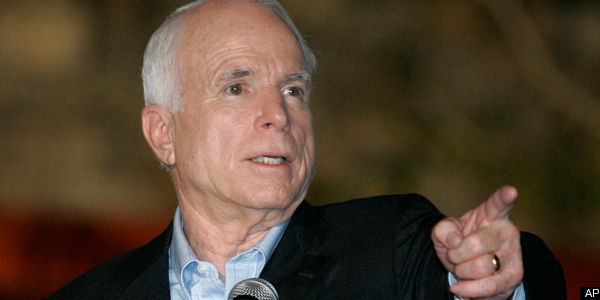
McCain: I'll Cut The Deficit By Winning Iraq War

Fact Check: No You Won't

Saturday, July 05, 2008

JERUSALEM = "CITY OF TRUTH"

What About Jerusalem?

July 4, 2008 | From theTrumpet.com

Wednesday’s terrorist attack has some Israelis calling for the division of their capital city.

Stephen Flurry

Jerusalem—Judging by the deafening blast of sirens and the sheer number of law enforcement vehicles—suvs, sedans, motorcycles, even mopeds—racing across town, we knew something terrible had just happened.

We were waiting for our bus Wednesday afternoon near the intersection of King George Street and Jaffa Road—one of Jerusalem’s busiest commercial districts. Less than a mile ahead of us, on Jaffa, a 30-year-old Arab construction worker had just begun a deadly game of bumper cars. Behind the wheel of a massive 50,000-pound front-end loader, Husam Dwayat rammed his foot on the accelerator and screamed “God is great!” Then, he proceeded to wildly bulldoze his way from one side of the street to the other—smashing everything in his path.

In the end, after this fit of squashing automobiles and tipping over buses, three Israeli women were left dead and dozens of others injured. A 20-year-old Israeli soldier, at home on leave from the army, ended the carnage as abruptly as it started, when he jumped onto the bulldozer, climbed into the cab and shot the terrorist in the head.

After boarding our chartered bus, with Jaffa now sealed off, our bus driver proceeded to circle around for an alternative route to Tel Aviv. We were headed to the Institute for National Security Studies to attend a briefing about specific proposals designed to push forward the often discussed two-state solution.

Maj. Gen. Giora Eiland (Ret.), formerly Israel’s national security adviser, made two proposals. His first plan called for Jordan to maintain control over a semi-autonomous Palestinian state in the West Bank (which Jordan doesn’t want). The second proposal was much more complicated—requiring Israel, Egypt and Jordan to give up land to the Palestinians in exchange for economic benefits mostly.

But what about Jerusalem? one reporter asked after his presentation.

“I don’t want to talk about Jerusalem now because it is out of the context of the presentation,” Eiland responded. “Jerusalem has nothing to do with this solution.”

Yet the tragedy on Jaffa that very day, together with the attack four months ago at Mercaz Harav Yeshiva, where an east Jerusalem Arab gunned down eight Jewish students, has thrust the Jerusalem question to front and center of the current debate about peace in the Middle East.

Calls to Divide the City

Wednesday’s unconventional attack highlights how creative terrorists can be when it comes to killing their enemies. But it also proves how difficult it has been for them to smuggle explosives across Israel’s 465-mile security fence. Since Israel constructed its “wall of defense” in response to the second intifada, suicide bombing attacks have virtually ground to a halt. Last year, for example, Palestinian terrorists killed 13 Israelis, compared to 426 in 2002.

The barrier that was designed to keep terrorists and explosives out, however, also works to keep more than 200,000 Palestinians in (a situation most Palestinians in Jerusalem prefer, by the way). These Arabs, equipped with Jerusalem residency cards, are allowed to move freely throughout the city and—as in the case of Dwayat—even work for Jewish construction companies. Terrorist groups outside the Green Line view the Palestinians in Jerusalem as a crucial pool of potential recruits since they are already inside Israel.

For Israel, the situation is worsened because of its standing as a free democracy, where all residents are meant to be treated equally. Immediately after Wednesday’s attack, Prime Minister Olmert, Defense Minister Barak and the mayor of Jerusalem all called for Dwayat’s home in the east Jerusalem neighborhood of Sur Bahir to be demolished in order to send a message to wannabe terrorists.

This is easier said than done, as Jerusalemites learned after the March shooting spree, when many government officials called for the same action but failed to act on it. As Calev Ben-David pointed out Thursday in the Jerusalem Post,

By granting special residency and potential citizenship status to Jerusalem’s Palestinians, Israel has opened up a hornet’s nest of problematic legal issues when it comes to carrying out retaliatory sanctions against them in the wake of terrorist attacks such as the one yesterday. For example, any home demolitions and expulsion orders against Arab residents and citizens will surely face judicial challenges that such actions violate the country’s basic laws against discrimination unless they are equally applied to its Jewish residents and citizens.

The complexity of this arrangement, together with the security benefits the fence has provided overall, is why more Israelis are warming to the idea of dividing Jerusalem. Just seven years ago, after Ehud Barak offered half of Jerusalem to Yasser Arafat, 400,000 Israelis protested the move at a demonstration near the Old City—Israel’s largest group protest ever.

Now, even before the two Jerusalem attacks this year, polls have shown dwindling support for the “one Jerusalem” platform. In December of 2005, one study suggested that about half of Israelis supported the idea of giving up parts of Arab east Jerusalem if it would solidify a peace deal with the Palestinians.

After Wednesday’s attack, some Jewish organizations were calling upon Israel’s government to immediately begin work on constructing additional barriers within Jerusalem. Yesterday, Israeli Vice Premier Haim Ramon said the West Bank barrier should be re-routed in order to exclude Arab neighborhoods from Israel. “These are Palestinian villages that were never part of Jerusalem. They were annexed to it in 1967,” Ramon said on Army Radio.

On Wednesday night, Prime Minister Olmert acknowledged that Israel must get tougher on perpetrators of terror. But “there is no way to fence off the Arabs of east Jerusalem and every home of a potential terrorist,” he said. With tens of thousands of Jews and Arabs living in neighborhoods that abut one another—all of them sharing the same parks, malls and government services—the task of carving up the city with a security fence would be nearly impossible.

Regular readers of theTrumpet.com know exactly where these events are leading. Backed by the authority of God’s Word, we have been saying for years that Jerusalem will eventually be split in half—but not the way most observers think!

Taken by Violence

As weak as Israel’s current government is—as much as it wants to give away land for peace—east Jerusalem will not be given away. God says it will be taken by violence! “Behold, the day of the Lord cometh …,” the Prophet Zechariah wrote, “and the city [Jerusalem] shall be taken, and the houses rifled, and the women ravished; and half of the city shall go forth into captivity, and the residue of the people shall not be cut off from the city” (Zechariah 14:1-2).

Of the 26 Israelis that have been killed by terrorists this year (already twice as many as were killed in 2007), nearly half have been murdered in the two Jerusalem attacks over the past four months.

What we are witnessing may be the earliest stages of violence that will result in half of Jerusalem falling into the hands of terrorists. God’s prophecies ought to be ringing in our heads like those siren blasts we heard on Wednesday!

Look again at Zechariah’s prophecy. Notice what’s presented right in the context of half of Jerusalem being taken captive: the appearance of the Messiah on Earth! (see verses 3 and 4).

So watch Jerusalem. It has everything to do with the solution God has in mind for ultimately bringing peace to the Middle East—and the entire world!

For much more on this subject, read our booklet Jerusalem in Prophecy. •

Wednesday, July 02, 2008

BILL MOYERS

It Was Oil, All Along

by: Bill Moyers and Michael Winship, t r u t h o u t | Perspective

photo
Bill Moyers. (Photo: Peter Krogh / AP)

Oh, no, they told us, Iraq isn't a war about oil. That's cynical and simplistic, they said. It's about terror and al-Qaeda and toppling a dictator and spreading democracy and protecting ourselves from weapons of mass destruction. But one by one, these concocted rationales went up in smoke, fire and ashes. And now the bottom line turns out to be ... the bottom line. It is about oil.

Alan Greenspan said so last fall. The former chairman of the Federal Reserve, safely out of office, confessed in his memoir, "Everyone knows: the Iraq war is largely about oil." He elaborated in an interview with The Washington Post's Bob Woodward, "If Saddam Hussein had been head of Iraq and there was no oil under those sands, our response to him would not have been as strong as it was in the first Gulf War."

Remember, also, that soon after the invasion, Donald Rumsfeld's deputy, Paul Wolfowitz, told the press that war was our only strategic choice. "We had virtually no economic options with Iraq," he explained, "because the country floats on a sea of oil."

Shades of Daniel Plainview, the monstrous petroleum tycoon in the movie, "There Will Be Blood." Half-mad, he exclaims, "There's a whole ocean of oil under our feet!" then adds, "No one can get at it except for me!"

No wonder American troops only guarded the Ministries of Oil and the Interior in Baghdad, even as looters pillaged museums of their priceless antiquities. They were making sure no one could get at the oil except ... guess who?

Here's a recent headline in The New York Times: "Deals With Iraq Are Set to Bring Oil Giants Back." Read on: "Four western companies are in the final stages of negotiations this month on contracts that will return them to Iraq, 36 years after losing their oil concession to nationalization as Saddam Hussein rose to power."

There you have it. After a long exile, Exxon Mobil, Shell, Total and BP are back in Iraq. And on the wings of no-bid contracts - that's right, sweetheart deals like those given Halliburton, KBR and Blackwater. The kind of deals you get only if you have friends in high places. And these war profiteers have friends in very high places.

Let's go back a few years to the 1990's, when private citizen Dick Cheney was running Halliburton, the big energy supplier. That's when he told the oil industry that, "By 2010 we will need on the order of an additional fifty million barrels a day. So where is the oil going to come from? While many regions of the world offer great oil opportunities, the Middle East, with two-thirds of the world's oil and the lowest cost, is still where the prize ultimately lies."

Fast forward to Cheney's first heady days in the White House. The oil industry and other energy conglomerates were handed backdoor keys to the White House, and their CEO's and lobbyists were trooping in and out for meetings with their old pal, now Vice President Cheney. The meetings were secret, conducted under tight security, but as we reported five years ago, among the documents that turned up from some of those meetings were maps of oil fields in Iraq - and a list of companies who wanted access to them. The conservative group Judicial Watch and the Sierra Club filed suit to try to find out who attended the meetings and what was discussed, but the White House fought all the way to the Supreme Court to keep the press and public from learning the whole truth.

Think about it. These secret meetings took place six months before 9/11, two years before Bush and Cheney invaded Iraq. We still don't know what they were about. What we know is that this is the oil industry that's enjoying swollen profits these days. It would be laughable if it weren't so painful to remember that their erstwhile cheerleader for invading Iraq - the press mogul Rupert Murdoch - once said that a successful war there would bring us $20-a-barrel oil. The last time we looked, it was more than $140 a barrel. Where are you, Rupert, when the facts need checking and the predictions are revisited?

At a Congressional hearing this week, James Hansen, the NASA climate scientist who exactly twenty years ago alerted Congress and the world to the dangers of global warming, compared the chief executives of Big Oil to the tobacco moguls who denied that nicotine is addictive or that there's a link between smoking and cancer. Hansen, whom the administration has tried again and again to silence, said these barons of black gold should be tried for committing crimes against humanity and nature in opposing efforts to deal with global warming.

Perhaps those sweetheart deals in Iraq should be added to his proposed indictments. They have been purchased at a very high price. Four thousand American soldiers dead, tens of thousands permanently wounded, hundreds of thousands of dead and crippled Iraqis plus five million displaced, and a cost that will mount into trillions of dollars. The political analyst Kevin Phillips says America has become little more than an "energy protection force," doing anything to gain access to expensive fuel without regard to the lives of others or the earth itself. One thinks again of Daniel Plainview in "There Will Be Blood." His lust for oil came at the price of his son and his soul.

Tuesday, July 01, 2008

"IRAN" in PROPHECY

Is Iran Trying To Start World War Three ?


Iran's nuclear pursuits seem geared to provoke Israel and/or the U.S. to attack
more so than to actually build an atomic bomb.

By J. Adams
The Spirit Of Truth Page
http://www.spiritoftruth.org
UPDATED: February 5th, 2006


"The nations of the world must not permit the Iranian regime to gain nuclear weapons."
- U.S. President George Bush's 2006 State Of The Union Address (source)

"Israel will not be able to accept an Iranian nuclear capability and it must have the capability to defend itself,
with all that that implies, and this we are preparing."
- Defence Minister Shaul Mofaz (source)

"Israel must be wiped off the map."
- Iranian President Mahmoud Ahmadinejad (source)

"If one day, the Islamic world is also equipped with weapons like those that Israel possesses now,
then the imperialists' strategy will reach a standstill because
the use of even one nuclear bomb inside Israel will destroy everything. . . .
It is not irrational to contemplate such an eventuality."

- Former Iranian President Ali Akbar Hashemi Rafsanjani (source)

"The battle in the Middle East is not against a rogue regime or two.
The battle is against a Russian-led alliance that refrains from publicly announcing its own existence.
The longstanding coordination between Baghdad, Damascus, Teheran and Moscow should be famous.
But who wants to acknowledge the truth? Who dares to understand?"
- Jeff Nyquist


Yesterday the International Atomic Energy Agency (IAEA) referred Iran to the United Nations Security Council for being in breach of the Nuclear Non-Proliferation Treaty's (NPT) safeguards agreement. Teheran has responded to the referral by ending diplomacy, stopping cooperation with the IAEA and starting "industrial scale" Uranium enrichment that could produce dozens of nuclear warheads per year.

Meanwhile, Israel (and the U.S.) is making preparations to launch a military strike to destroy Iran's nuclear facilities and set the Islamic nation's nuclear pursuits back years. The prospect of a nuclear-armed Iran, led by its new, rabidly anti-semitic President Mahmoud Ahmadinejad, who has denied the Holocaust and called for Israel to be "wiped off the map", is intolerable for the Jewish state. Iran's nuclear program constitutes an "existential threat" for Israel that, if not mitigated by international diplomacy, Jerusalem will stop with military force similar, but far larger in scope, to the 1981 air strike on Iraq's Osirak nuclear reactor. Iran's ending diplomacy and start of industrial-scale reprocessing of enriched uranium might be enough to trigger the threatened Israeli attack. Reportedly, in December Prime Minister Sharon ordered Israeli Defense Forces to be prepared to attack Iran by the end of March.

If Israel strikes Iran's nuclear facilities, Teheran has threatened to retaliate by, at the least, launching ballistic missiles at Israel. Presumably these missiles, unlike the SCUDs launched against Israel by Saddam Hussein during the Gulf War, will carry chemical and/or biological warheads. Iranian-backed Hezbollah forces in southern Lebanon could likewise launch a barrage of missiles into northern Israel on Iran's behalf. Furthermore, Syria, which has forged a military alliance with Iran, would likely be drawn into the fray of any conflict and could launch SCUD missiles armed with weapons of mass destruction (some leftover from Iraq) against Israel as the fourth full-scale Arab/Israeli War gets underway.

Should such a conflict erupt, it is important that the world understand the true cause. In this regard, one needs to understand that the current international crisis concerning Iran's nuclear pursuits is not what it seems. There's an ulterior motive behind what's happening.

The most important reason the IAEA concluded that Iran was violating the NPT was a set of documents discovered in Teheran that could only be used for the purpose of building an atomic bomb. These documents constitute the proverbial "smoking gun" that led the IAEA to refer Iran to the U.N. Security Council. But how did the IAEA get its hands on these sensitive Iranian documents?

Newsweek recently reported the following:

Then there’s the problem with the papers Iran did cough up. Last fall, after more than two years keeping the IAEA waiting, the Iranians finally produced two cardboard boxes full of papers which they allowed inspectors to examine only in an Iranian government office in Teheran. As the IAEA’s people read through the documents, they came across about 10 pages that looked suspicious, to say the least: general specifications for casting uranium metal in a spherical form that could well make up the core of an atomic bomb. In a curious arrangement, the Iranians videotaped the inspectors while they were looking at the papers, but wouldn’t allow the IAEA to make any photographs or copies. The IAEA wants to get those documents in its hands, and it wants to know what the hell they were doing in the files of Iran’s “peaceful” program to begin with. (Newsweek, "Countdown To A Showdown", Jan. 23, 2006)

The problem is, why did Iran cough up this set of documents? These "two cardboard boxes full of papers" were provided after a two year wait by the IAEA. One would think that Iranian intelligence would have carefully scrutinized each and every page that was to be handed over. They had two years to do so. Yet, there were 10 pages there about how to shape uranium metal into a spherical form, information that could only be used in building a nuclear bomb. So why were these incredibly incriminating pages handed over? It seems like Teheran intentionally provided information that directly revealed its pursuit of a nuclear bomb.

Another surprising admission by Iran is that it is has tens of thousands of centrifuges that will now be used for "industrial scale" reprocessing that can produce enough highly enriched uranium for dozens of nuclear bombs per year. The U.S. National Intelligence Assessment, a consensus view of U.S. agencies, has been that Iran will not have a nuclear weapon until 2010 at the earliest. However, there's been growing concern about Iran's secret Natanz uranium reprocessing facility. Iranian opposition sources said Teheran built centrifuges for its nuclear plant at Natanz without the knowledge of the IAEA and the European Union (EU). New construction at Natanz reportedly includes underground centrifuge cascade halls for a fuel enrichment plant designed to contain around 50,000 centrifuges. According to Paul Leventhal, president of the Washington-based Nuclear Control Institute, "If the information obtained by the Iranian opposition can be verified, then we have a major crisis on our hands." Indeed, outside specialists believe that, if the reports are correct about Natanz, then Iran is only months or a year away from having its first crude nuclear device.

Any doubts about whether Iran was assembling a massive fuel enrichment capacity were put to rest in late-January when Teheran's IAEA Ambassador, Ali Asghar Soltanieh, said that, should his nation be referred to the U.N. Security Council, Iran will start "commercial industrial scale enrichment" using "more than 50,000 centrifuge machines....with the capacity of [producing] 30 tons [of enriched uranium] per year" (of which around a ton would be highly-enriched, bomb-grade material). This point was further buttressed after the IAEA's vote on Saturday when Soltanieh told Newsweek that Iran can produce enriched uranium "by the ton". Of course, why has Iran's IAEA point person made such revealing threats? Up to when Soltanieh made his comments, there was only uncorroborated speculation by Iranian opposition sources that Iran was developing a huge enrichment capacity. By making his threats, Soltanieh exposed Teheran's secret enrichment pursuits. Such a revelation could only exacerbate Western, and more so Israeli, concerns that Iran is close to having a nuclear bomb.

Iran's nuclear program became far more alarming in the past several months because of the election of the nation's new president, Mahmoud Ahmadinejad, who has made numerous bellicose, anti-semitic remarks since taking office. Ahmadinejad's background and religious beliefs are about as disturbing as possible for Israel and the West. According to the BBC’s world affairs editor John Simpson, “Ahmadinejad was a founder of the group of young activists who swarmed over the embassy wall and held the diplomats and embassy workers hostage for 444 days”. In other words, he was one of the architects of the Iran hostage crisis from 1979 to 1981. What's worse, the Iranian leader has an apocalyptic outlook and suffers from some sort of messianic complex. He is purportedly a mahdaviat who is expecting the imminent return of Islam's 12th Imam to save the world and wishes to sow the chaos necessary for this to occur (more). In fact, there is reason to suspect Ahmadinejad thinks he is the returning Moslem saviour. Even high-level officials in Iran have told the West that the man is "certifiably insane".

So how is it that Mahmoud Ahmadinejad was elected Iran's president in the first place? Well, the odds are he wasn't. Ahmadinejad was most likely intentionally placed in power by Iran's ruling clerics.

Consider the following. Mahmoud Ahmadinejad predicted with "no doubt" his June election victory, months in advance, at a time when polls gave him barely 1 percent support. After the June 17th, 2005 presidential election in Iran, as the votes were still being tallied, Ahmadinejad, who had hovered at the back of the field of candidates in pre-election opinion surveys, announced hours before the Interior Ministry issued its own results that he would be in the runoff. How is it Mahmoud Ahmadinejad was so certain that he would be elected Iran's new president when all the polls indicated he was not even in the running? An obvious explanation is that the election was rigged and the "certifiably insane" candidate knew the ultimate outcome ahead of time. Indeed, even moderates in Iran who usually don't speak out declared that the election was rigged. Iran's Guardian Council, a panel controlled by hard-line clerics that has the ultimate say over all government actions, was behind the vote counting that resulted in Ahmadinejad's win. As Russian dictator Stalin so aptly put it: “The people who cast the votes don't decide an election, the people who count the votes do.”

But why would Iran's ruling elite want to make such an apparent madman president?

By intentionally giving the presidency to an apocalyptically-minded, anti-semitic extremist who threatened to destroy Israel after taking office and then intentionally letting the IAEA and West know that an atomic bomb is being built, apparently sooner than later, Teheran is provoking Israel and/or the U.S. into preemptively attacking. This, I would dare say, IS the intent. Iran is baiting Israel and America to take military action against its nuclear facilities. If Teheran's intention was to complete building an atomic bomb, then it should have discretely continued clandestine efforts to do so rather than announcing to the world it's capabilities and intentions such that Israel and/or the U.S. militarily eliminate the developing threat. The course that Iran has chosen to follow seems geared to provoke an attack more so than to actually complete development of a nuclear weapon.

The problem with the historical course now unfolding is that there is reason to believe it is scripted by the enemies of freedom not just in Teheran but, more importantly, Moscow. This might seem hard to believe, since Russia now appears to be a friend of the West, but alas this friendship is most likely untrue:

“War to the hilt between communism and capitalism is inevitable. Today, of course, we are not strong enough to attack. Our time will come in thirty to forty years. To win, we shall need the element of surprise. The bourgeoisie ... will have to be put to sleep. So we shall begin by launching the most spectacular peace movement on record. There will be electrifying overtures and unheard of concessions. The capitalist countries, stupid and decadent, will rejoice to cooperate in their own destruction. They will leap at another chance to be friends. As soon as their guard is down, we will smash them with our clenched fist. ” - Dimitri Manuilski of the Lenin School for Political Warfare [1933]

When Gorbachev took power in 1985, Moscow did a sudden about face that eventually led to the seeming collapse of Communism, the breakup of the Soviet Union and a "New World Order" in which Russia and America, the two nuclear superpowers, are friends. Unfortunately, this positive turn of world events, which seemed to bring an end to the spectre of global nuclear war, was most likely deceptive:

“Comrades, do not be concerned about all you hear about glasnost and perestroika and democracy in the coming years. They are primarily for outward consumption. There will be no significant internal change within the Soviet Union other than for cosmetic purposes. Our purpose is to disarm the Americans and let them fall asleep.” - Mikhail Gorbachev in a speech to the Soviet Politburo, November 1987

The reality is that Russia had long realized that the only way to defeat the West would be to trick America into disarming as much as possible and then launch a surprise nuclear attack. Furthermore, to gain world control after the dust settles, Russia wouldn't want to appear culpable for a global nuclear holocaust. World War Three would need to appear to be the West's fault. Hence, Moscow devised and implemented "The Perestroika Deception", a long-term plan by which the West has been lulled into a false sense of security. Russian Communism came to an end, the Soviet Union collapsed and America, history's greatest proponent of freedom and democracy, emerged as the world's sole hegemon. Misperceiving the Russian military threat, the Western powers have gradually dismantled Cold War military capabilities and the U.S. has subtantially reduced its nuclear arsenal as part of disarmament agreements signed with Moscow. Meanwhile, former Soviet puppet states, through military aggression and terrorism, have become thorns in the side of the free world drawing the U.S. and its allies into military action against nations like Serbia, Afghanistan and Iraq. American military assertiveness, in turn, has been characterized to the world as Western imperialism by our former enemy-of-old and modern leftists.

The focus of the provocations has increasingly centered on the Middle East where the long-standing Arab-Israeli conflict has been simmering and ready to explode into a superpower conflict since the state of Israel was established in 1948. Indeed, it could be that the nuclear confrontation between the U.S. and Russia during the last full-scale Arab-Israeli war in 1973, the Yom Kippur War, gave Moscow the historical precedent upon which they modeled a future scenario for triggering a global nuclear war that will end in their favor. What's more, Israel's 1981 air strike on Iraq's Osirak nuclear reactor, which received international condemnation, may have given Moscow an idea for the most effective way to provoke the next Arab-Israeli War in a manner that appears to be "The Jews" fault.

Hence, over the past several years, Russia has been helping Iran develop nuclear and ballistic missile technology that poses an existential threat to Israel. This includes the construction of the Bushehr nuclear power plant that is the primary focus of current international concern. What's more, Russia produced and launched an Iranian spy satellite that can be used to detect an Israeli preemptive military strike against Iran and will soon arm Teheran with effective defensive weaponry such that Israel is under pressure to act sooner than later. [More specifically, in December Russia agreed to sell Iran $1 billion in arms, including $700 million worth of advanced surface-to-air missiles (SAMs), the TOR-M1. The TOR-M1 would pose a deadly threat to aircraft involved in any strike against Iran's nuclear-related targets. The imminent delivery of this weapon system is pushing Israel to act sooner than later.]

Strangely, in helping Iran develop nuclear and ballistic missile weaponry, Russia is seemingly acting against its own national interests. Iran, an extremist Islamic state, has long been known as a sponsor of international terrorism. Russia, stemming from its war in Chechnya, has purportedly been a repeat victim of Islamic terrorists (although some question the true source of terrorism against Russia). Hence, it seems to make little sense that Russia is helping to provide the world's ultimate Islamic extremist state with the means by which to build and launch nuclear bombs as far as Moscow. Yet, this is how history is unfolding. Could it be that Russia doesn't feel threatened by the Islamic radicals in Teheran? If not, why? Could it be because Iran is a Russian surrogate?

(Ayatollah) Khomeini's revolutionary movement was known as "Islamic Marxism," a movement begun from within the Russian Bolshevik Party in 1916. During the 1970s, the Soviet Union mobilized its resources to organize a revolution in Iran, with Khomeini as its official leader. Khomeini's brother was serving time in prison as a member of the Tudeh Party—the Communist Party of Iran; Khomeini's intimate advisor, Sadegh Ghothzadeh, was an affiliate of the French and Italian Communist Parties. Soon the Soviets were broadcasting pro-Khomeini propaganda into Iran, while they began publishing a well-funded revolutionary magazine entitled Navid, meaning "Good News." KGB agents working among the 4,000 Soviet personnel in Iran coordinated the protests and riots, and the Tudeh Party, acting on Soviet orders, openly backed the "Islamic" revolution and created a broad coalition of the Left to support Khomeini.

Moscow also mobilized the PLO to back Khomeini. The Popular Front for the Liberation of Palestine, led by self-proclaimed Marxist Leninist George Habash, supplied training and weapons to the Feda'iyin-e Khalq, the Iranian Islamic-Marxist terrorist group that began the revolution to overthrow the Shah. Meanwhile, Yasser Arafat's Fatah organization trained and armed the Mujahedin-e Khalq, another main pillar of Khomeini's revolution, and it trained future members of the Revolutionary Guards of Iran, including the Minister of the Guards later appointed by Khomeini.

Once Khomeini seized power in Iran, Arafat brought a large delegation of PLO officials into the country, where "he was formally given the Israeli consulate building and, raising the Palestinian flag over it, opened the first PLO office, also appointing a PLO 'ambassador' to Iran." The Soviet Union and Communist China have since continued to arm Iran with weapons.

Khomeini immediately created Hezballah as an international terrorist wing of the PLO-trained Revolutionary Guards. Inside Iran, Hezbellah worked closely with Iranian Communist organizations in consolidating the regime's power. The terrorist training camps in Iran have been supervised by Mostafa Chamran Savehi, a follower of Trotskyite Communism who, as a student in Berkeley, California during the 1960s, founded such Islamic-Marxist groups as Red Shi'ism and the Muslim Students' Association of America. The instructors at the Iranian terrorist camps have been Communist experts from North Korea and Syria, as well as Iranians trained by the PLO and the Communist government of Iraq. (source)

If Iran is acting on behalf of Moscow in creating an existential threat against Israel, then an incredible international deception is underway. But what would be the purpose? A possible explanation is that Iran is intentionally provoking a war with the Jewish state in order to set the stage for Russia's involvement. Moscow has a military cooperation agreement with Teheran and is a long-time ally of Syria, which has a mutual defense pact with Iran. Russian involvement in a new Arab/Israeli war, in turn, will lead to a confrontation with the U.S. since America backs Israel and now has significant forces in the region due to the War On Terror. Thus, there is the potential for a nuclear exchange, something that will come as quite a surprise, resulting in the destruction of Israel and the U.S. and bringing an end to Western world dominance. The way in which this is being done is geared to make the U.S. and Israel appear responsible for triggering the nuclear war that will result in their own demise. Thus, Russia can militarily conquer the world and not appear culpable for the associated nuclear holocaust.

On a final note, fifteen years ago I had what I believe may have been some sort of prophetic vision, a premonition that I fear could soon prove true. In early February of 1991, during the Gulf War, I saw a special report of a chemical missile attack on Israel that did not exist. (Israel went off alert the following day because there had been no Iraqi SCUD missile attacks for some time). About a week after seeing this, a friend and I heard an air-raid siren and nuclear explosion upon reading aloud the 8th chapter from the Bible's Book of Revelation - the Seventh Seal prophecy that I've long believed depicts a future global nuclear war.

As I have tried to share with others my apocalyptic vision of the future, I've been told that I suffered a hallucination. What's more, in explaining to others how my vision might prove true, I've been told that I'm suffering from paranoia. But could it be that I'm not really insane? Rather, might it be man as a species that is suffering from madness such that the world will eventually experience what I've foreseen?

Hopefully not, but time will tell...

Blog Archive